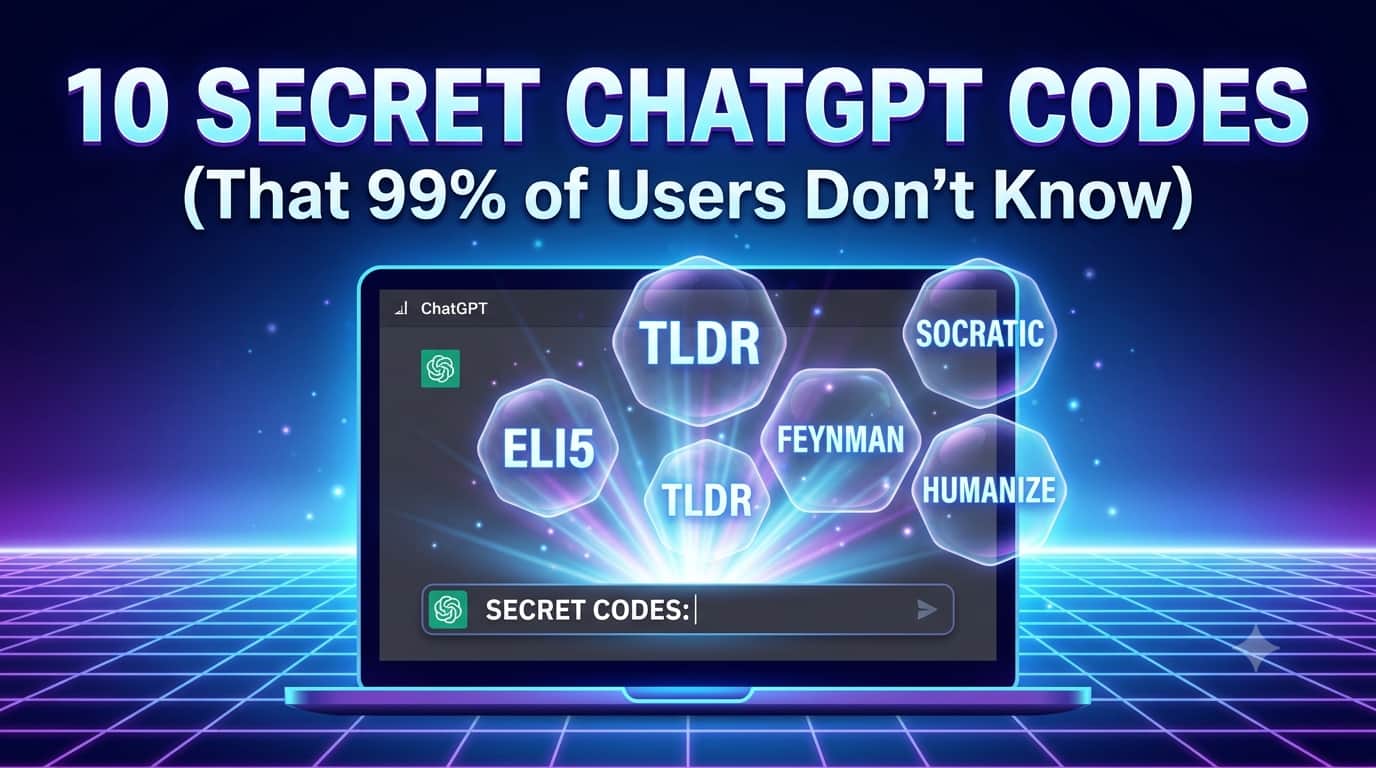
10 Secret ChatGPT Codes and Directives That 99% of Users Don’t Know (2026 Guide)
Most people use ChatGPT with single-line, open-ended questions like “Write a blog post about marketing” or “Summarize this meeting.” While the model complies, the output is frequently generic, repetitive, and bloated with conversational fluff. What separates casual AI users from seasoned power users is the strategic application of system directives, formatting codes, and constraint syntax.
Large language models are deterministic pattern matchers steered by probability. By injecting specific trigger words and behavioral codes into your prompts, you instantly shift ChatGPT out of its default conversational mode into specialized execution states: executive briefing, rigorous logic auditing, structural JSON extraction, or first-principles tutoring. Below are the 10 most powerful secret ChatGPT codes and prompt directives you can use in 2026 to unlock professional-grade responses.

1. ELI5 (Explain Like I’m 5): First-Principles Deconstruction
When studying complex technical concepts—such as vector embeddings, blockchain consensus, or quantum cryptography—default explanations are often packed with dense academic terminology. Adding the code ELI5 commands the model to translate complex systems into physical analogies and everyday sensory metaphors.
[CODE / DIRECTIVE]:
"ELI5: How does Retrieval-Augmented Generation (RAG) work in enterprise AI?"

[WHY IT WORKS]:
It forces the LLM to strip away jargon, limit sentence complexity, and employ relatable metaphors (e.g. comparing vector search to an open library filing index rather than cosine similarity across multidimensional embeddings).
2. TL;DR + Actionable Takeaways: The Executive Synthesis Code
If you paste a 3,000-word contract, quarterly earnings report, or research whitepaper into ChatGPT, a standard summary will still produce 500 words of passive prose. Adding TL;DR: Executive Briefing Format forces structural brevity.
[CODE / DIRECTIVE]:
"TL;DR [Paste Text]
Format Output Strictly As:
1. Core Thesis (Under 20 words)
2. Top 3 Strategic Implications (Bullet points)
3. Immediate Action Items with Owners & Deadlines"
This transforms overwhelming data dumps into clean, decision-ready memos suitable for c-suite leadership or project team briefings.
3. Socratic Mode: The Critical Thinking & Discovery Code
Standard ChatGPT immediately provides direct answers, which often prevents you from thinking through problem edge cases yourself. By triggering Socratic Mode, you instruct the AI never to solve the problem directly, but instead guide you through sequential questioning.
[CODE / DIRECTIVE]:
"Act as a master business strategist using Socratic Mode. I want to build a SaaS tool for freelance video editors. Do NOT give me the solution or business plan yet. Instead, ask me 3 probing, uncomfortable questions about my market distribution and unit economics. Wait for my answers before proceeding."
4. Chain-of-Thought (CoT): “Think Step-by-Step” for Zero Hallucinations
Numerous machine learning benchmarks have demonstrated that appending “Think step-by-step and write out your reasoning before giving the final answer” improves mathematical, legal, and logical reasoning accuracy by up to 40%. It enables the model to utilize reasoning tokens to evaluate premise validity before generating the conclusion.
5. Strict JSON / Output Schema Enforcer
When feeding AI outputs into downstream automation pipelines (like WordPress, Zapier, n8n, or Python scripts), you cannot afford polite introductory chatter like “Sure! Here is the JSON you requested:”. Use this strict syntax enforcer:
[CODE / DIRECTIVE]:
"Extract the key entities from [Text].
Output ONLY valid RFC-8259 JSON matching this schema:
{
  \"entities\": [{\"name\": \"string\", \"category\": \"string\", \"sentiment_score\": \"float\"}]
}
NO conversational markdown, NO intro, NO backticks."
6. Pre-Mortem / Devil’s Advocate Audit Code
ChatGPT is trained via reinforcement learning to be agreeable and helpful. Consequently, if you present a flawed marketing idea, it will often praise it enthusiastically. To overcome this sycophancy bias, use the Pre-Mortem Protocol:
[CODE / DIRECTIVE]:
"Assume it is 12 months in the future, and my launch of [Product/Project] has been a complete, catastrophic failure. Write a brutally honest post-mortem analysis detailing the top 5 blind spots, market miscalculations, and execution bottlenecks that caused this disaster."
7. Few-Shot Pattern Anchor: High-Precision Styling
Rather than writing 20 adjectives describing your desired tone (e.g. “witty, modern, authoritative, crisp”), provide 2 concrete input-output examples. This technique, known in prompt engineering as Few-Shot Prompting, forces mathematical alignment with your exact vocabulary rhythm and formatting style.
8. Temperature & Tone Calibration Directives
While API developers can adjust the numerical temperature parameter (from 0.0 to 1.0), web chat users can emulate this precision using calibrated vocabulary codes:
| Code / Directive | Effective Temperature | Best Use Case |
|---|---|---|
| “Deterministic Mode” | 0.0 – 0.2 | Coding syntax, data extraction, legal compliance, financial calculations |
| “Balanced Editorial Mode” | 0.5 – 0.7 | Technical tutorials, business proposals, documentation, email communication |
| “Divergent Ideation Mode” | 0.9 – 1.0 | Brainstorming brand names, fiction writing, lateral thinking challenges |
9. The Reverse Interviewer Framework
If you have an incomplete concept and do not know all the requirements, instruct the AI to conduct an intake interview. This puts the burden of thoroughness onto the model:
[CODE / DIRECTIVE]:
"I want to write a comprehensive hiring rubric for an AI automation engineer. You are an expert technical recruiter. Before writing anything, interview me with 5 specific technical questions to clarify our tech stack, budget, and seniority level."
10. Jargonize vs. De-Jargonize Translator
Whether you need to turn casual meeting notes into an impressive board room memo or convert dense enterprise software documentation into consumer-friendly marketing copy, pairing the codes Jargonize and De-Jargonize allows immediate linguistic refactoring without losing the core message.
Summary: How to Integrate These Codes into Daily Workflows
Mastering prompt directives turns ChatGPT from an unpredictable toy into a dependable cognitive co-processor. Save these 10 code frameworks in your personal prompt library or note-taking tool. By combining structured directives with clear contextual boundaries, you will consistently generate outputs that require minimal editing and deliver maximum commercial value.