AI for Investment: How to Use AI to Make Smarter Financial Decisions
Most retail investors make decisions based on three things: tips from friends, headlines they half-read, and gut feeling about companies they have heard of.Professional fund managers use something very different. Quantitative analysts running machine learning models on decades of market data. Natural language processing systems scanning thousands of earnings calls and news articles per hour. AI risk engines calculating portfolio correlations in real time.
The gap between how professionals invest and how everyone else invests has historically been enormous.
AI is closing that gap.
The tools that hedge funds built for themselves are now being packaged into platforms any investor can access — at a fraction of the cost. Whether you are investing in stocks, ETFs, mutual funds, crypto, or property, AI tools can help you research smarter, diversify better, and manage risk more systematically.
This guide covers how to use AI at every stage of the investment process — from initial research to portfolio management to tax optimisation.

Where AI Adds Real Value in Investing
Before looking at specific tools, understand where AI genuinely improves investment decisions — and where it does not.
| AI Genuinely Helps With | AI Does Not Reliably Help With |
|---|---|
| Screening thousands of stocks against your criteria | Predicting short-term price movements |
| Analysing company fundamentals faster | Timing the market perfectly |
| Identifying historical patterns in market data | Eliminating all investment risk |
| Monitoring your portfolio for risk concentration | Guaranteeing returns |
| Sentiment analysis across news and social media | Accounting for truly unpredictable events |
| Tax-loss harvesting and rebalancing | Replacing your own judgment on what matters to you |
The most valuable thing AI does in investing is remove emotion from the analytical process. Fear and greed are the two biggest destroyers of investment returns. AI systems do not feel either.
Type 1 — AI Robo-Advisors: Automated Portfolio Management
Robo-advisors are AI-powered platforms that manage your entire investment portfolio automatically. You answer questions about your goals and risk tolerance — the AI builds and manages a diversified portfolio for you.
| Platform | Best For | Cost |
|---|---|---|
| Betterment (betterment.com) | Best overall robo-advisor — tax-loss harvesting, automatic rebalancing, socially responsible portfolios | 0.25% annual fee |
| Wealthfront (wealthfront.com) | Best for advanced features — direct indexing, risk parity, financial planning integration | 0.25% annual fee |
| Schwab Intelligent Portfolios | No management fee — requires $5,000 minimum but zero advisory cost | Free |
| M1 Finance (m1.com) | Hybrid robo/self-directed — you choose the stocks and ETFs, AI handles rebalancing | Free / Plus $3/mo |
| Stash (stash.com) | Best for beginners — fractional shares, AI guidance, very low minimums | From $3/month |
💡 Robo-advisors are best for long-term, passive investors who want diversification and automatic management without needing to make daily decisions. They are not designed for active trading or crypto.
Type 2 — AI Stock Screeners and Research Tools
If you prefer to choose your own investments, AI screeners help you filter thousands of stocks down to the ones that match your strategy.
| Tool | What It Does | Cost |
|---|---|---|
| Finviz (finviz.com) | Powerful stock screener with 60+ filters — find stocks matching any fundamental or technical criteria | Free / Elite $24.96/mo |
| Trade Ideas (trade-ideas.com) | AI-powered stock scanner — Holly AI generates trade ideas in real time based on historical pattern matching | From $84/month |
| Danelfin (danelfin.com) | AI scores every S&P 500 stock 1–10 based on probability of beating the market in the next 3 months | Free / Pro |
| Kavout (kavout.com) | AI “K-Score” ranks stocks by predicted performance using machine learning on fundamental and technical data | Contact for pricing |
| Tickeron (tickeron.com) | AI pattern recognition — identifies chart patterns and provides confidence scores on predicted outcomes | From $17/month |
| Seeking Alpha (seekingalpha.com) | AI-powered investment research — Quant ratings, AI earnings analysis, news sentiment scoring | From $19.99/month |
Practical screening workflow for a value investor:
- Open Finviz screener
- Filter: P/E under 20, debt-to-equity under 0.5, positive earnings growth over 3 years, sector of your choice
- Export the list (usually 20–50 stocks)
- Run each through Danelfin for AI performance probability score
- Use ChatGPT or Claude to summarise the last earnings call for your top 5 candidates
- Invest in the ones that pass all three layers
Type 3 — AI for Fundamental Analysis
Reading company earnings reports, 10-K filings, and analyst reports is time-consuming and technically complex. AI makes it accessible.
Using ChatGPT / Claude for fundamental analysis:
Prompt examples that work:
“Summarise the key risks mentioned in Apple’s most recent 10-K filing for a retail investor. Focus on competitive threats, regulatory risk, and revenue concentration.”
“Compare the revenue growth, profit margins, and debt levels of Microsoft and Alphabet over the last 3 years. Which looks stronger from a value perspective?”
“Explain what the P/E ratio, PEG ratio, and price-to-book ratio tell me about a stock’s valuation, and how to use them together.”
| AI Tool | Best Use in Fundamental Analysis |
|---|---|
| ChatGPT Plus | Summarise filings, explain financial ratios, compare companies |
| Claude | Longer documents — paste entire earnings transcripts for analysis |
| Earnings Whispers (earningswhispers.com) | AI earnings calendar — tracks estimates vs actuals, surprise history |
| AlphaSense (alpha-sense.com) | Institutional-grade AI search across filings, transcripts, and research — used by hedge funds |
| Quartr (quartr.com) | Free app — access earnings calls, investor presentations, and AI summaries for thousands of companies |
Type 4 — AI Sentiment Analysis for Markets
Markets move on emotion as much as fundamentals. AI sentiment tools measure that emotion systematically.
| Tool | What It Measures | Cost |
|---|---|---|
| Sentimentrader (sentimentrader.com) | Tracks 100+ sentiment indicators — options positioning, fund flows, survey data — with AI pattern matching | From $39/month |
| LunarCrush (lunarcrush.com) | Social media sentiment for crypto assets — tracks mentions, engagement, and sentiment shifts | Free / Pro |
| Accern (accern.com) | NLP sentiment analysis on news articles — used by institutional investors | Enterprise pricing |
| MarketPsych (marketpsych.com) | Sentiment data from news and social media integrated directly into Bloomberg and Refinitiv | Institutional |
| Fear & Greed Index (cnn.com/markets/fear-and-greed) | Simple daily market mood score — useful as a contrarian indicator | Free |
How to use sentiment as a contrarian tool:
Professional investors use sentiment inversely — extreme fear is often a buying opportunity, extreme greed is often a signal to reduce risk. AI sentiment tools let you quantify what “extreme” actually means, rather than relying on your own emotional read of the market.
Type 5 — AI for Portfolio Risk Management
Choosing investments is only half the job. Managing how they interact with each other — and how much risk you are carrying — is where most retail investors have the biggest gap.
| Tool | What It Does | Cost |
|---|---|---|
| Portfolio Visualizer (portfoliovisualizer.com) | AI-powered backtesting and risk analysis — test any portfolio against historical data | Free |
| Composer (composer.trade) | Build and automate investment strategies with no code — AI helps design rules-based portfolios | From $19/month |
| Riskalyze / Nitrogen (nitrogenwealth.com) | AI risk scoring for your portfolio — identifies concentration risk, volatility, and drawdown probability | Advisor-focused |
| Koyfin (koyfin.com) | AI-powered portfolio analytics — correlation analysis, factor exposure, performance attribution | Free / Pro $39/mo |
| Empower (empower.com) | Free AI investment checkup — analyses your existing accounts for fees, allocation, and risk | Free |
The most important risk concept AI can help you monitor:
Correlation — when all your investments fall at the same time, diversification has failed. AI portfolio tools calculate the correlation between every holding and flag when your “diversified” portfolio is actually moving together.

AI Investing for Pakistani and South Asian Investors
Most of the platforms above are primarily US-focused. Here is what is accessible and relevant for investors in Pakistan:
| Option | What Is Available |
|---|---|
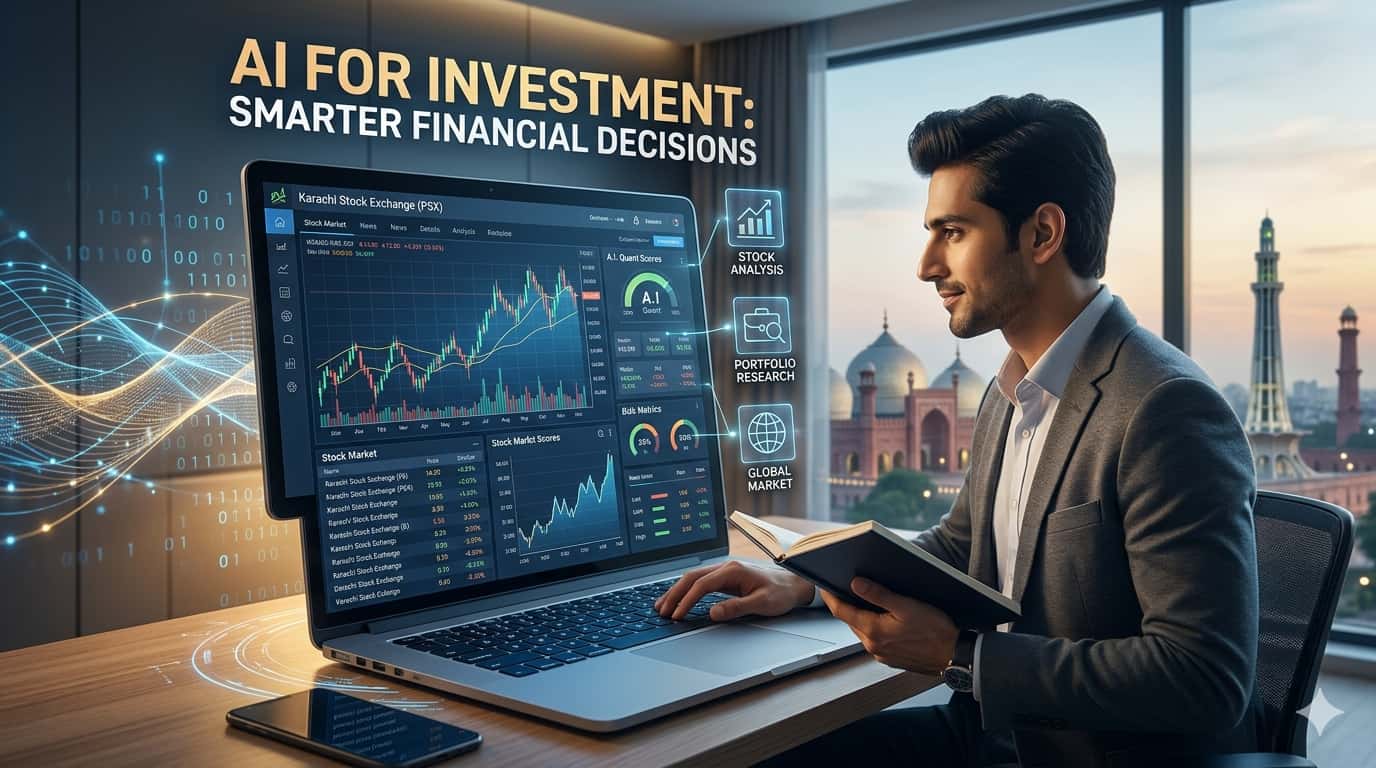
| Pakistan Stock Exchange (PSX) | AI screeners for PSX are limited — Tradingview covers PSX data and allows custom AI-assisted screening |
| Crypto investing (Binance, Bybit) | Accessible via P2P — AI tools from 3Commas, Pionex work globally |
| Global stocks via international brokers | Interactive Brokers and Exness offer access to US and global markets from Pakistan — AI tools apply fully |
| Gold investing | Gold is a traditional Pakistani investment — AI commodity sentiment tools at Sentimentrader apply |
| Robo-advisors | Most are US-only — Sarwa (sarwa.co) is a robo-advisor serving MENA and South Asia |
📌 For Pakistani investors, combining TradingView (technical analysis + AI indicators) with ChatGPT (fundamental research and news analysis) provides a powerful, accessible, and low-cost investment research setup.
AI Investment Mistakes That Cost Real Money
- Treating AI signals as certainties — every AI prediction carries probability, not certainty. Never size a position as if an AI prediction is guaranteed.
- Overfitting to backtests — an AI strategy that produced 200% returns in historical testing has been optimised for past conditions. Past performance does not predict future results.
- Ignoring macroeconomic context — AI models trained on stock data alone can miss the impact of interest rate changes, geopolitical events, or currency moves. Always layer in macro awareness.
- Using leverage with AI signals — combining leverage with AI trade signals is one of the fastest ways to blow up a trading account. AI is wrong often enough that leverage turns small errors into account-ending losses.
- Chasing AI-promoted “hot stocks” — social media is full of accounts using “AI analysis” to promote specific stocks. This is marketing, not analysis. Verify every claim independently.
A Practical AI Investment Stack by Budget
Free Stack
| Purpose | Tool |
|---|---|
| Stock screening | Finviz (free) |
| Portfolio analysis | Portfolio Visualizer (free) + Empower (free) |
| Research assistant | ChatGPT free + Claude free |
| Market sentiment | CNN Fear & Greed Index (free) |
| Earnings data | Quartr (free) |
| Charts and indicators | TradingView (free plan) |
Paid Stack (Under $50/month)
Everything above plus:
- Seeking Alpha Premium ($19.99/month) — AI quant ratings and deep research
- ChatGPT Plus ($20/month) — advanced analysis, longer documents, data analysis
- Danelfin Pro ($~10/month) — AI performance scoring on individual stocks
The Bottom Line
Investing has always rewarded patience, discipline, and information quality over everything else. AI does not change what works — it makes what works more accessible and more systematic.
You do not need a Bloomberg terminal. You do not need a quantitative analyst. You need a stock screener, an AI research assistant, a risk analysis tool, and the discipline to follow a process rather than react to noise.
The investors who will outperform over the next decade are not the ones who find the best tips. They are the ones who build the best process — and AI tools are the most powerful process-building resources individual investors have ever had access to.
Start with the free stack. Learn what each tool tells you. Build a system you understand and can follow consistently.
Consistency beats cleverness. Every time.
⚠️ Disclaimer: This article is for educational and informational purposes only. Nothing in this post constitutes financial advice. All investing involves risk, including the risk of losing the capital you invest. Always do your own research and consider consulting a licensed financial advisor before making investment decisions. AI tools are decision-support systems — final investment decisions are your responsibility.