
Best AI Side Hustles: Real Ways to Make Extra Money with AI Tools
Every “AI side hustle” article promises the same thing: quit your job, make six figures, do it all in your sleep.That is not what this is. This is a realistic look at side hustles where AI genuinely gives you an edge not because AI does all the work for you, but because it lets one person do work that used to require a team, a large budget, or years of specialized skill. Some of these can realistically earn a few hundred extra dollars a month. A few, with consistent effort, can grow into a full income. None of them are passive, and none of them work without you putting in real effort to learn the tool and find clients.
Here are the side hustles where AI is making the biggest practical difference right now, what tools you need, and how to actually get started.
1. AI-Assisted Freelance Writing
Content demand has not slowed down if anything, the volume of content businesses need has grown. What has changed is that one writer using AI well can now produce what used to take a small team.
Tools to use: ChatGPT or Claude for drafting and research, Grammarly for polishing, Surfer SEO or Yoast for optimisation
How to start:
- Build a small portfolio of 3-5 sample articles in a niche you understand even if AI-assisted, edit heavily so the final piece reflects genuine quality
- Create profiles on Upwork, Contra, or directly pitch small businesses and blogs in your niche
- Be transparent with clients that you use AI as part of your process most clients care about quality and turnaround, not the exact workflow
- Price based on value delivered (a well-researched, edited 1,500-word article), not on the false assumption that AI makes the work worthless
Realistic income range: A part-time freelancer writing 4-6 articles per week can reasonably earn a meaningful supplemental income; full-time writers building a steady client base can scale well beyond that.
Honest caveat: The market is more competitive now precisely because AI lowered the barrier to entry. Quality editing and genuine expertise in a niche is what separates a sustainable writing side hustle from a race-to-the-bottom one.
2. AI Image and Design Services
Small businesses, Etsy sellers, and content creators constantly need graphics social posts, product mockups, thumbnails and most cannot afford a traditional designer.
Tools to use: Midjourney or Leonardo AI for image generation, Canva for assembling final designs, Adobe Firefly for commercially safe client work
How to start:
- Pick a specific niche YouTube thumbnails, Etsy product mockups, or Instagram carousel templates are all in steady demand
- Build a small portfolio showcasing before/after examples or sample packs
- List services on Fiverr or Etsy (selling templates directly), or reach out directly to small business owners
- Offer package deals for example, “10 social media graphics for your brand” rather than one-off pricing
Realistic income range: Highly variable based on niche and volume, but design gigs in the $20-100+ range per project are common starting points on freelance platforms.
Honest caveat: Always check the commercial usage terms of whichever AI image tool you use Adobe Firefly is generally the safest for client work since it is trained only on licensed images.
3. AI Chatbot Setup Services for Small Businesses
Most small business owners have heard that AI chatbots exist but have no idea how to actually set one up. That gap is an opportunity for someone willing to learn one platform well and offer it as a service.
Tools to use: Tidio, Shopify Inbox, or similar platforms covered in chatbot setup guides
How to start:
- Learn one chatbot platform thoroughly set one up for your own test website first to genuinely understand the process
- Reach out to local small businesses, especially e-commerce stores, that clearly do not have one
- Offer a flat-rate setup package for example, configuring the bot, training it on their FAQ, and testing it before handover
- Consider a recurring monthly fee for ongoing maintenance and updates, which creates more stable income than one-off setups
Realistic income range: Setup fees can range widely depending on business size and complexity; recurring maintenance contracts can add steady monthly income on top.
Honest caveat: This hustle benefits significantly from some existing technical comfort, though most chatbot platforms are genuinely designed for non-developers.
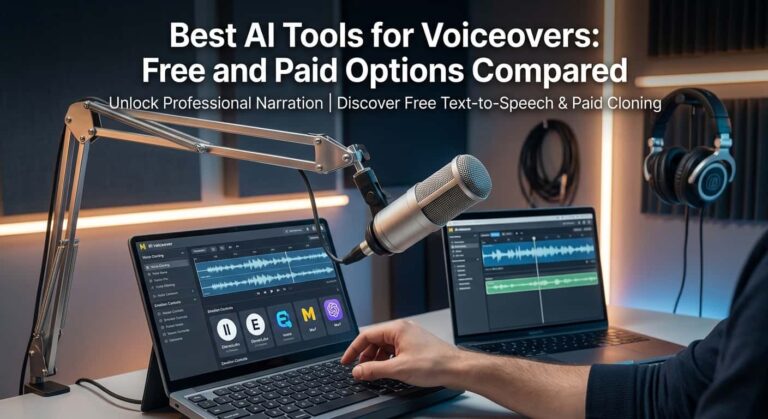
4. AI Voiceover and Audio Services
Text-to-speech AI has reached a quality level where it is genuinely usable for commercial projects explainer videos, audiobook samples, YouTube narration and there is steady demand from creators who do not want to record themselves.
Tools to use: ElevenLabs for realistic AI voice generation, Descript for editing and cleanup
How to start:
- Test a few AI voice tools and find the ones that sound most natural for different content types (narration vs conversational)
- Build sample clips across a few different tones and styles to showcase range
- Offer services on Fiverr for YouTube narration, explainer video voiceovers, or audiobook sample chapters
- Always check the specific platform’s licensing terms for commercial voice use before taking client work
Realistic income range: Per-project voiceover gigs are common on freelance platforms, with pricing generally tied to script length and turnaround time.
Honest caveat: Some clients specifically want a human voice for authenticity reasons be upfront that you are offering AI-generated voiceover as a faster, lower-cost alternative, not pretending it is a human recording.
5. Selling AI-Generated Print-on-Demand Designs
Print-on-demand platforms let you sell designs on t-shirts, mugs, and posters without holding any inventory AI image tools make creating a large catalog of designs dramatically faster than manual design work.
Tools to use: Midjourney or Leonardo AI for designs, Printful or Printify for production and fulfillment, Etsy or Shopify for the storefront
How to start:
- Pick a specific niche audience rather than generic designs niche audiences have less competition and more loyal buyers
- Generate and refine a batch of designs around that niche theme
- Set up a Printful or Printify integration with an Etsy or Shopify store
- Test a handful of designs with small ad spend or organic posting before scaling up your catalog
Realistic income range: Highly dependent on niche, marketing effort, and design quality; most sellers describe this as a slow-build side income rather than a fast win.
Honest caveat: This is one of the more saturated AI side hustles since the barrier to entry is so low differentiation through niche selection and genuine design quality matters more here than almost anywhere else on this list.
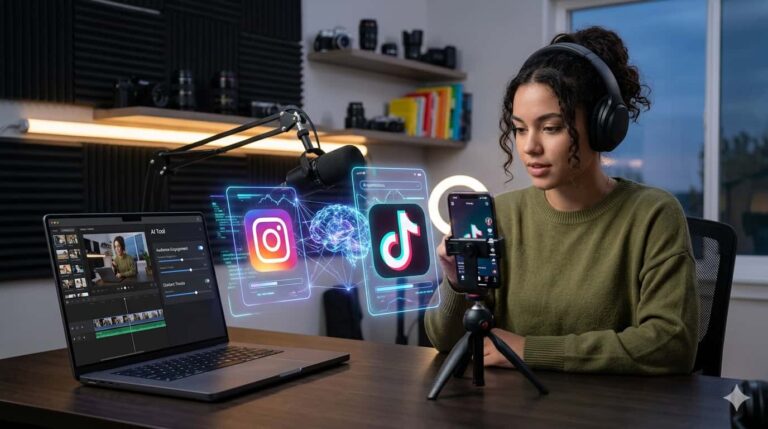
6. AI-Assisted Video Editing and Content Repurposing
Businesses and creators constantly need long-form content (podcasts, webinars, YouTube videos) cut into short clips for social media a task that AI tools have made dramatically faster.
Tools to use: CapCut for short-form editing, Descript for transcript-based editing, Opus Clip for automatically finding clip-worthy moments in long videos
How to start:
- Practice on your own or a friend’s long-form content first to build a small portfolio
- Offer a specific, clear service “I will turn your podcast into 5 short clips per week” is easier to sell than vague “video editing services”
- Reach out to podcasters, YouTubers, or coaches who post long-form content but have no social media clip strategy
- Price as a recurring weekly or monthly service rather than one-off projects, since most clients need this consistently
Realistic income range: Recurring clip-cutting services for content creators are commonly priced as ongoing monthly retainers rather than single payments, which can create more predictable income over time.
Honest caveat: AI tools like Opus Clip speed up finding good moments, but final editing judgment and matching the creator’s style still requires a human touch this is not a fully automated service.
7. AI Prompt Engineering and Consulting
As more businesses adopt AI tools internally, there is growing demand for people who can help teams use ChatGPT, Claude, or other AI tools more effectively writing better prompts, building internal workflows, and training staff.
Tools to use: Deep familiarity with ChatGPT, Claude, and relevant automation tools like Zapier or Make
How to start:
- Document your own effective prompts and workflows for common business tasks as proof of expertise
- Offer a short, focused service a half-day workshop or a documented prompt library for a specific department
- Target small businesses that have heard about AI but have not implemented it well internally
- Build case studies from your own work or early clients to demonstrate concrete time savings
Realistic income range: Consulting work tends to command higher rates than production-based gigs since you are selling expertise and time savings, not a deliverable like an image or article.
Honest caveat: This hustle requires genuine, demonstrable expertise it is harder to fake than a portfolio of AI-generated images, but it can also command significantly better rates once you have a track record.
Quick Comparison Table
| Side Hustle | Startup Cost | Skill Barrier | Income Potential |
|---|---|---|---|
| AI-assisted writing | Low | Moderate (editing skill matters) | Moderate to high with steady clients |
| AI image/design services | Low | Low to moderate | Moderate, niche-dependent |
| Chatbot setup services | Low | Moderate (some technical comfort helps) | Moderate, with recurring revenue potential |
| AI voiceover services | Low | Low | Low to moderate per project |
| Print-on-demand AI designs | Low | Low | Low to moderate, slow-build |
| Video editing/repurposing | Low to moderate | Moderate | Moderate, strong recurring potential |
| AI prompt consulting | Low | High (requires real expertise) | Moderate to high per engagement |
How to Choose the Right One for You
Ask yourself these questions before picking a side hustle to start with:
- Do I already have a related skill? Writers should start with AI-assisted writing. Designers should start with AI image services. Build on what you already know rather than starting completely from zero.
- How much time do I actually have per week? Chatbot setup and consulting are lower time-volume but require more upfront learning. Print-on-demand and content repurposing tend to need more consistent ongoing effort.
- Do I want one-off projects or recurring income? Chatbot maintenance, video clip services, and consulting retainers tend to build more predictable recurring income than one-off writing or design gigs.
- Am I comfortable being client-facing? Every option here eventually requires finding and communicating with clients AI handles production, not sales and relationships.
Common Mistakes That Stop AI Side Hustles From Working
- Treating AI output as a finished product in every category above, the side hustles that succeed involve real editing, curation, and judgment on top of the AI output, not just forwarding raw AI results to a client
- Competing purely on price since AI lowered the barrier to entry, undercutting on price is a race to the bottom; competing on niche expertise and quality holds up better
- Not being upfront with clients about AI use most clients do not mind AI being part of your process, but being caught hiding it damages trust badly
- Spreading across too many side hustles at once picking one, learning the tools deeply, and finding a few solid clients works better than dabbling in five different hustles simultaneously
- Expecting it to be passive every hustle on this list still requires ongoing client communication, quality control, and marketing effort
The Bottom Line
AI has not created free money. What it has created is leverage the ability for one person with the right tools and a genuine skill to do work that used to require more time, more people, or more specialized training.
The side hustles that actually work long-term are the ones where you combine an AI tool with something uniquely yours your editing judgment, your niche knowledge, your client relationships, your design taste. The AI handles the repetitive heavy lifting. You still have to handle the parts that require a human.
Pick one from this list that matches a skill you already have, or are genuinely interested in building, learn the tools properly, and start reaching out to your first few clients. Consistency over a few months matters far more than which specific hustle you choose.